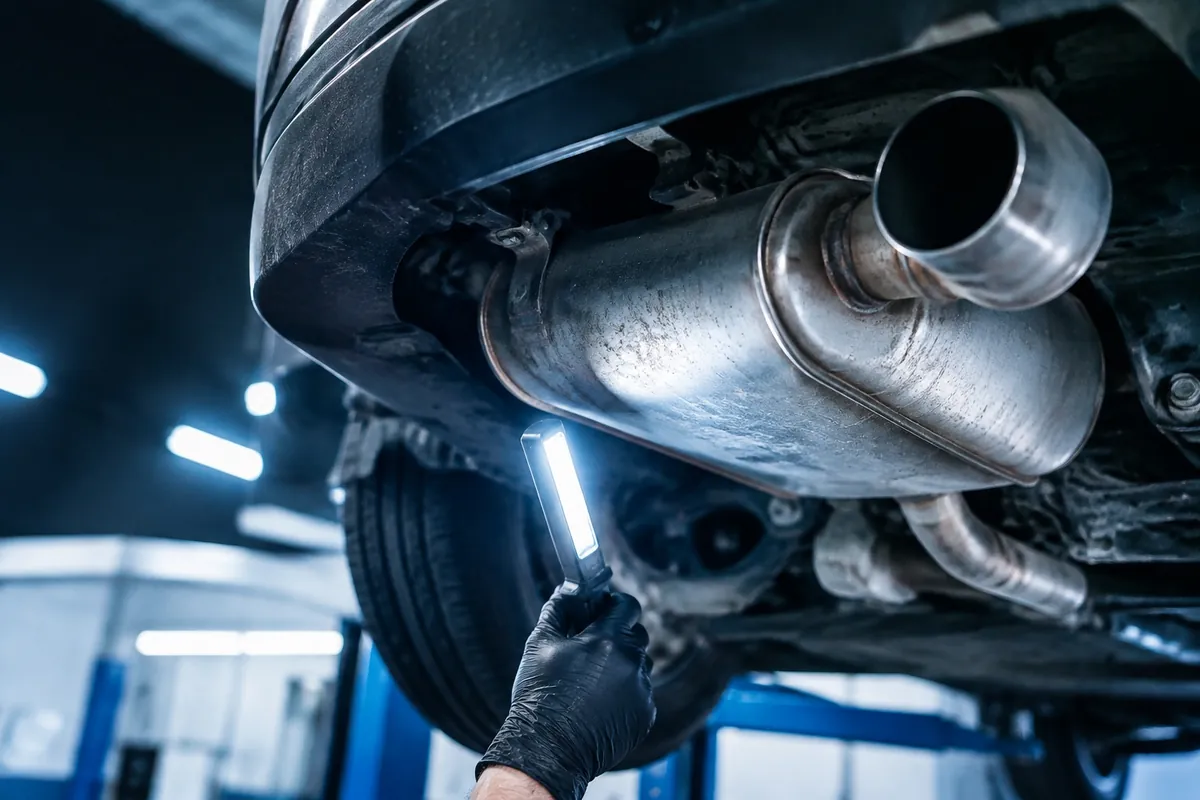
Your car’s exhaust system has a very important job: taking the toxic gases your engine produces and carrying them safely away from you and your passengers. It isn’t a system that makes the car “go,” so drivers aren’t always sure whether a problem really needs to be fixed right away. Plenty of people wait until the check engine light comes on, or until the car gets too loud to ignore.
Let’s walk through the basics, so you can see why even this out-of-sight system deserves some care. (This all applies to hybrids too, since they still have a gas engine. Fully electric cars are the only ones with no exhaust at all.)
How does the exhaust system work?
Your engine is basically a pump. It brings in fuel and air and turns them into motion, heat and exhaust gases. The exhaust system takes those hot gases and moves them along quickly. Here are the parts that make up the system, in order, and what each one does for you.
Exhaust manifold
Also called the exhaust header, this is a set of tubes that collects the exhaust from each cylinder of the engine and combines it into one pipe. It can be made of cast iron, steel or aluminum, and it has to be sealed completely at each cylinder so no exhaust escapes.
Oxygen sensors
Modern cars have at least two oxygen sensors: one near the exhaust manifold and one after the catalytic converter. They measure how much oxygen is in your exhaust and report to the engine’s computer, which uses the readings to keep the engine running efficiently and to confirm the converter is doing its job. When a sensor starts to fail, it will usually turn on your check engine light, and it can cost you gas mileage.
Catalytic converter
The catalytic converter sits between the exhaust manifold and the muffler, and it reduces the toxins in your exhaust. What comes in is a mix of carbon monoxide, nitrogen oxides and hydrocarbons. Precious metals inside the converter cause a chemical reaction that turns most of that into water vapor and carbon dioxide, which are far less harmful.
The exhaust pipe
The exhaust pipe runs between all of these parts on the trip from the engine to the tailpipe. Its job is to move hot exhaust through the system quickly, without letting it cool. It’s made of steel that is built to resist corrosion, but over time it can still rust.
Muffler
The muffler is a chamber with a series of tubes inside that quiets the sound coming from your engine. An internal combustion engine is, after all, a lot of contained explosions. The muffler has to absorb and control that noise while still letting the exhaust flow smoothly to the tailpipe, and it has to stand up to heat and corrosion while it does.
Some of the main issues to look out for
The most common problem with these parts is rust. It can start from the inside (lots of short trips speed it up, because the system never gets hot enough to dry out) and from the outside, which is no surprise with as many wet months as we get around here. Mufflers are the part you’re most likely to see rust out and need replacing.
Catalytic converters can become clogged. Oxygen sensors simply wear out over time, and depending on the vehicle they are usually due somewhere between 60,000 and 100,000 miles. Leaks anywhere in the system should be handled right away. They’re bad for your car and dangerous for you, because you don’t want carbon monoxide finding its way into the cabin.
Signs your exhaust needs attention
- The car is louder than it used to be, or you hear a rumble or a hiss that’s new.
- Something rattles underneath, especially at idle or over bumps.
- You smell exhaust inside the car, or a rotten-egg smell from the tailpipe.
- The check engine light is on.
- The car suddenly roars when you start it. That can mean the catalytic converter has been stolen. Thieves go after them for the precious metals inside, and hybrids and trucks are frequent targets around the Puget Sound area.
If you notice any of these, have it looked at soon. Our muffler and exhaust repair page explains what we check.
Trust your mechanic, or find one you can trust
This is a line we say often. It’s common for people to feel they’re being “upsold” when the car isn’t showing obvious signs of failure yet. A thorough mechanic will see the signs well before there’s a breakdown, and will recommend replacing parts to keep this important system healthy. The bottom line: you should be able to trust your mechanic’s recommendations and stay ahead of these issues. If you can’t, find a shop you can trust.
Might we suggest KC Martin Automotive in Lynnwood? We’ve been looking after our customers’ vehicles since 1948, and we’d be glad to show you how we do it.